Repurposing fatty-acid autoxidation for PHB–PMMA multiblock copolymers
- Post by: Ozgur Keles
- September 1, 2025
- Comments off
Oxidation is usually treated as a degradation pathway. In a 2025 Scientific Reports study, Baki Hazer, Özgür Keleş, and Ebru Kılıçay asked whether autoxidized unsaturated fatty acids could instead provide reactive sites for constructing a more complex polymer architecture.
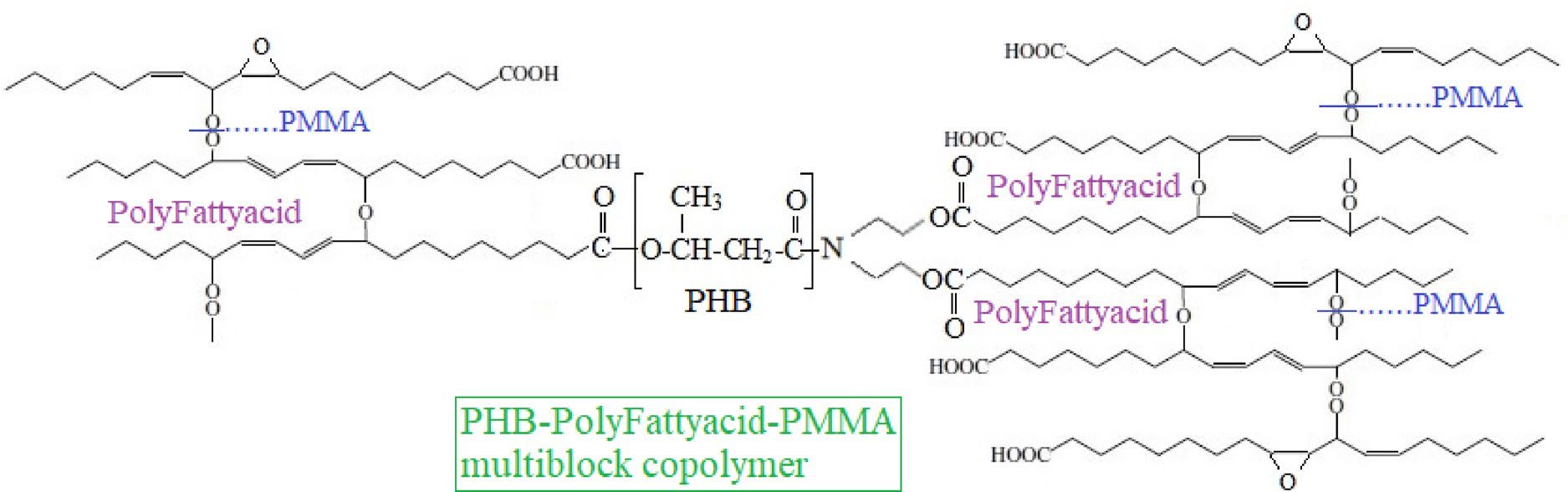
The route begins by converting polyhydroxybutyrate (PHB) to hydroxylated PHB and coupling it to peroxide-bearing segments derived from autoxidized oleic, ricinoleic, or linoleic acid. At 85 °C, decomposition of those peroxide sites generated macroradicals that initiated conventional free-radical polymerization of methyl methacrylate. The result was a family of branched PHB–poly(fatty acid)–PMMA multiblock copolymers.
No single measurement establishes that architecture by itself. The study instead combined 1H and 13C NMR, DOSY, FTIR, size-exclusion chromatography, and fractional precipitation. The six synthesized systems contained 9–16 mol% PHB. Among the samples characterized by SEC, the number-average molecular weight reached 146 kDa.
Thermal analysis and microscopy then showed how composition altered material behavior. PHB-segment melting transitions appeared between approximately 100 and 155 °C, and intermediate glass-transition temperatures appeared near 40–54 °C. The onset of PHB-segment degradation shifted approximately 10–15 °C above neat PHB. SEM images also changed from a porous PHB–fatty-acid morphology to layered structures after incorporation of PMMA blocks.
This is a synthesis-and-characterization result, not evidence that the complete copolymers are biodegradable, mechanically superior, environmentally preferable, or ready for manufacturing. Its scientific value is more specific: a normally unwanted oxidation process was repurposed as a source of initiating sites, and complementary measurements were used to test the resulting multiblock design.
The article was published in Scientific Reports 15, 32084 (2025), with Özgür Keleş as corresponding author. The work acknowledges Kapadokya University Research Funds and partial support from NSF CAREER Award 2145604.
Featured image: Expected design of the PHB–poly(fatty acid)–PMMA multiblock copolymers, Figure 6 from Hazer, Keleş, and Kılıçay, Scientific Reports 15, 32084 (2025). Source article. Reproduced unchanged under the CC BY-NC-ND 4.0 license; resized automatically by WordPress for web display.