Surface chemistry matters: modeling graphene-quantum-dot/epoxy mechanics
- Post by: Ozgur Keles
- January 26, 2026
- Comments off
Adding a nanofiller is not enough. In graphene-quantum-dot (GQD)–epoxy nanocomposites, the chemistry at the particle–polymer interface can determine whether load is transferred effectively.
Led by first and corresponding author Swapnil S. Bamane, with Prathamesh P. Deshpande, Folarin Erogbogbo, and Ozgur Keles, our open-access study, “Enhancing the mechanical properties of epoxy with graphene quantum dots: a molecular dynamics study,” appears in RSC Applied Polymers, Volume 4, pages 753–766.
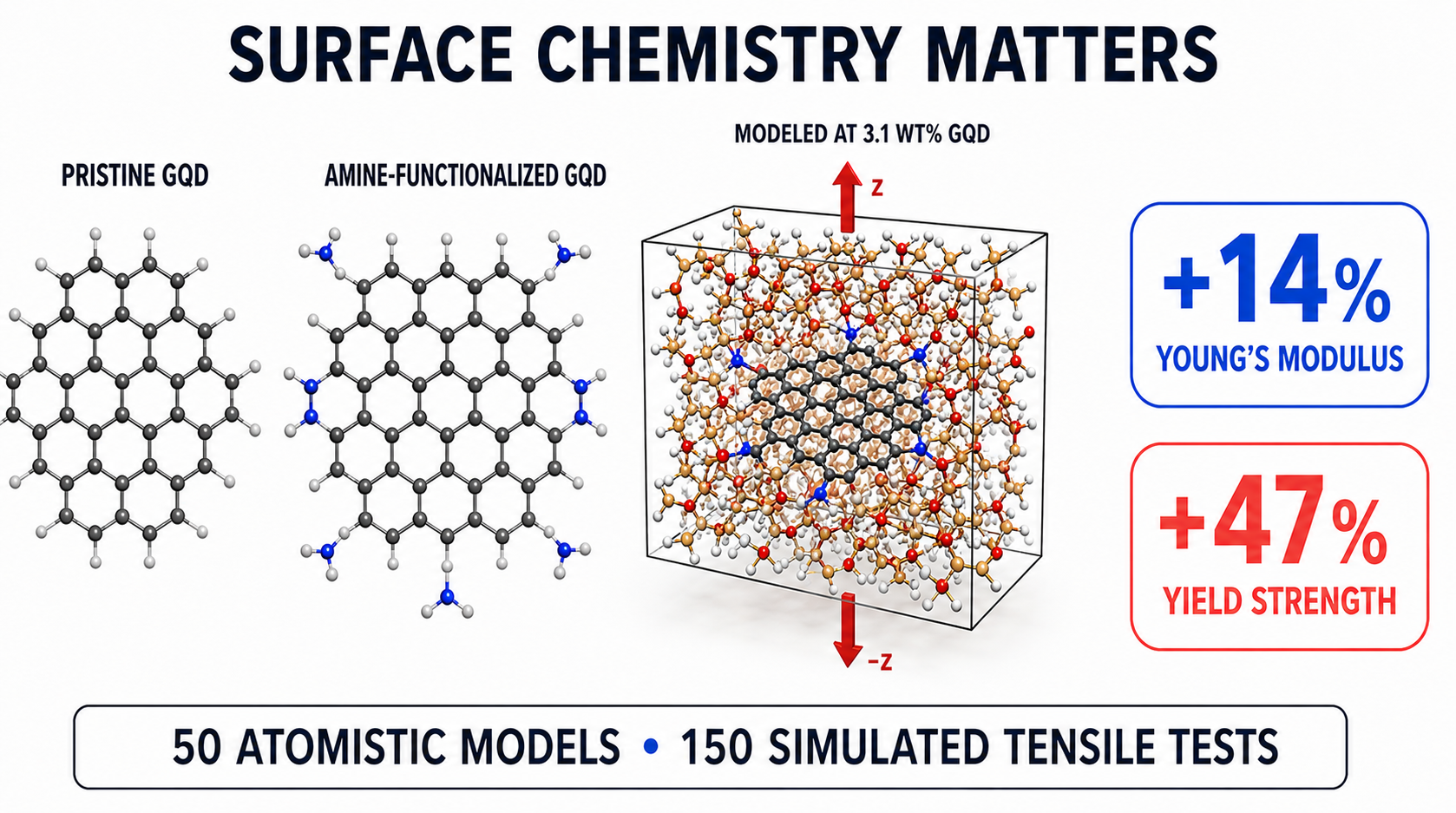
At a fixed 3.1 wt% GQD loading, the study examined nine GQD surface chemistries plus neat epoxy using five independent atomistic models per system. Loading each model in three directions produced 150 simulated tensile tests. Fixed-bond IFF predictions were also compared with ReaxFF, while the neat-epoxy predictions were benchmarked against published experimental measurements.
Surface chemistry produced a clear modeled contrast. Amine-functionalized GQDs gave the strongest response: about 14% higher Young’s modulus and 47% higher yield strength than neat epoxy, with the e6N-GQD system reaching a predicted yield strength of 85 ± 9 MPa. Pristine GQD increased the modeled modulus by 8% but did not improve yield strength. No statistically significant change in predicted Poisson’s ratio was found.
These nanocomposite gains are computational predictions, not experimental validation. They provide testable candidates for matched-loading synthesis and mechanical testing, particularly direct comparisons between pristine and amine-functionalized GQDs.
The work was supported by NSF CAREER award 2450841 and used UNC Charlotte’s STARLIGHT high-performance computing cluster. The modeling scripts, structures, tensile-test files, and free-volume analyses are openly archived.