Where hydroxyl groups sit matters in modeled GQD-epoxy interfaces
- Post by: Ozgur Keles
- January 2, 2026
- Comments off
Chemical functionalization is often treated as a question of how many groups are added. This study asked a more specific design question: where on a graphene quantum dot should hydroxyl groups sit to change its modeled interface with epoxy?
Prathamesh P. Deshpande and Ozgur Keles presented the work at the American Society for Composites 39th Annual Technical Conference in San Diego in October 2024. It is now archived by Springer as “Investigating Effects of Oxidation of Graphene Quantum-Dot in Epoxy Composites—A Molecular Dynamics Study” in Performance and Durability of Composite Materials, Volume 2. The chapter was published online January 2, 2026, on pages 179–187.
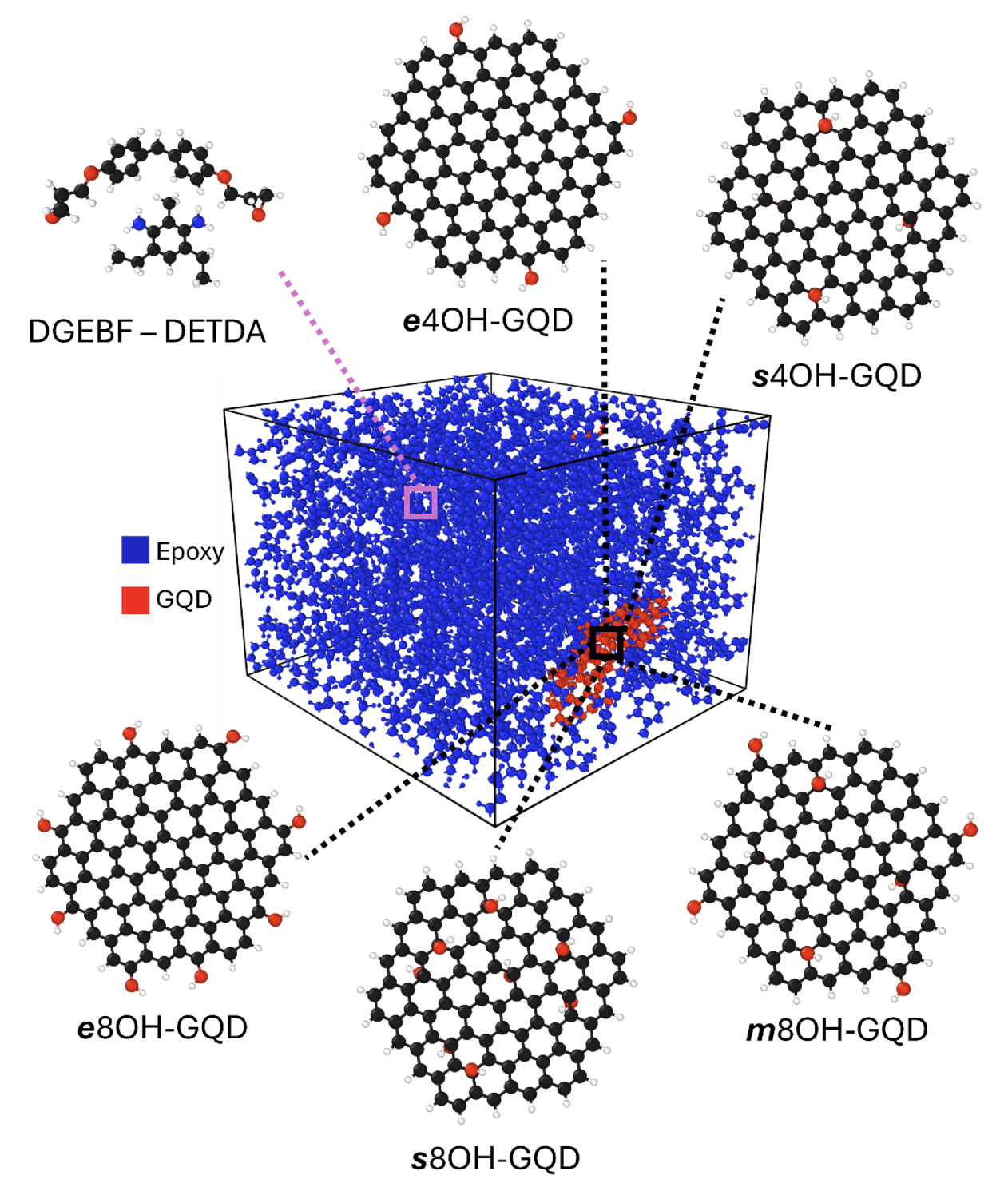
Using atomistic molecular dynamics, the study compared neat DGEBF/DETDA epoxy with five approximately 2 nm hydroxylated GQD variants. Hydroxyl groups were placed at the edges, on the basal plane, or at mixed locations. Five independent models per system were deformed in three directions.
The model ranking points to topology. Basal-plane hydroxylation generally produced stronger predicted responses than edge-only placement. The s8OH-GQD system had the highest modeled Young’s modulus, 3.48 ± 0.05 GPa versus 2.94 ± 0.06 GPa for neat epoxy. The m8OH-GQD system had the highest modeled yield strength, 134.72 ± 1.86 MPa versus 109.4 ± 1.59 MPa for neat epoxy. Predicted density remained essentially unchanged at 1.23–1.24 g cm−3.
These are comparative simulations, not experimental validation. The applied strain rate of 2 × 10⁸ s−1 makes the absolute yield-strength predictions much higher than experimental values. The useful outcome is a ranking of testable surface-chemistry designs for synthesis and mechanical testing—not material qualification.
The work was supported by NSF CAREER award 2145604. Calculations used Anvil at Purdue through ACCESS allocation MAT230078 and the San José State University College of Engineering high-performance computing cluster. The chapter preserves an early, topology-focused stage of our continuing GQD–epoxy research.