From quantum dots to carbon-fiber composites: what should we test next?
- Post by: Ozgur Keles
- June 25, 2026
- Comments off
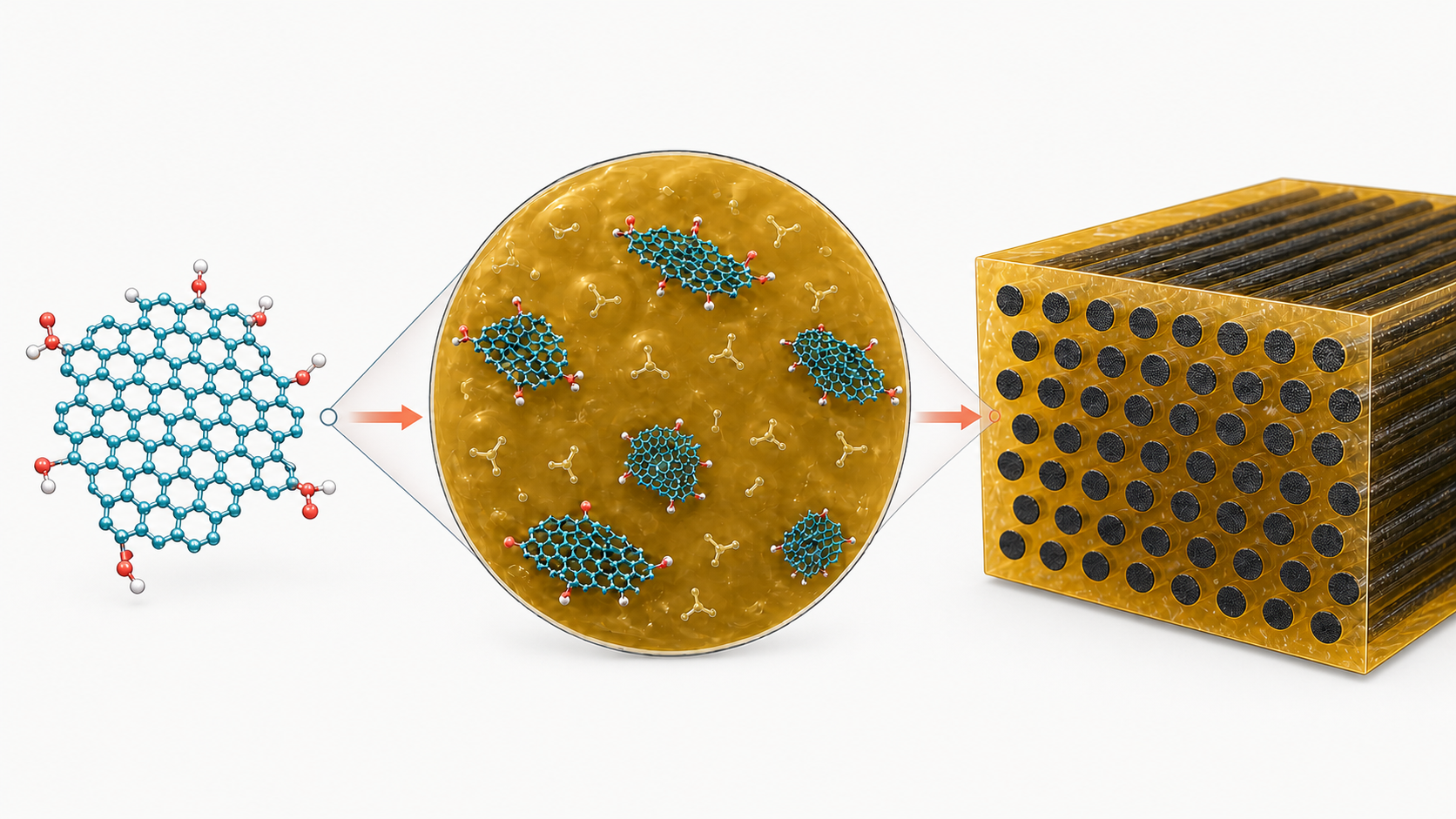
One recurring problem in materials design is that an improvement predicted at the nanoscale does not automatically become a better structural composite. Our new paper asks that question directly for graphene quantum dots (GQDs) in epoxy/carbon-fiber systems.
Led by Swapnil S. Bamane, “Multi-scale modeling of hierarchical hybrid graphene quantum dot–epoxy/carbon fiber composite” connects molecular-dynamics simulations at the nanoscale with micromechanics at larger length scales. Within the modeled systems, GQD reinforcement reduced predicted epoxy cure shrinkage by 29%, increased predicted epoxy Young’s modulus by 30%, and increased the predicted transverse modulus of the hierarchical composite by 21%.
What matters to me is not the simulation alone. The framework connects GQD concentration and functionalization to matrix-level cure shrinkage, free volume, and stiffness, and then to composite-scale response. It therefore gives us a more disciplined way to decide which formulations and interfaces deserve experimental time.
As simulation tools become more accessible, their scientific value will increasingly depend on whether they produce testable decisions. The next question is experimental: do these predicted gains survive synthesis, dispersion, cure, interfacial stress, fracture, and service conditions?
The work was supported by U.S. National Science Foundation CAREER award 2450841, with calculations performed on UNC Charlotte’s STARLIGHT high-performance computing cluster.