How GQD functionalization shifts modeled epoxy thermal behavior
- Post by: Ozgur Keles
- August 20, 2025
- Comments off
Thermal stability is not a property of “adding graphene” in general; it depends on the chemistry of the interface. In an open-access Applied Nano study, we used all-atom molecular dynamics to ask how graphene-quantum-dot functionalization changes the thermal response of a bisphenol-F epoxy.
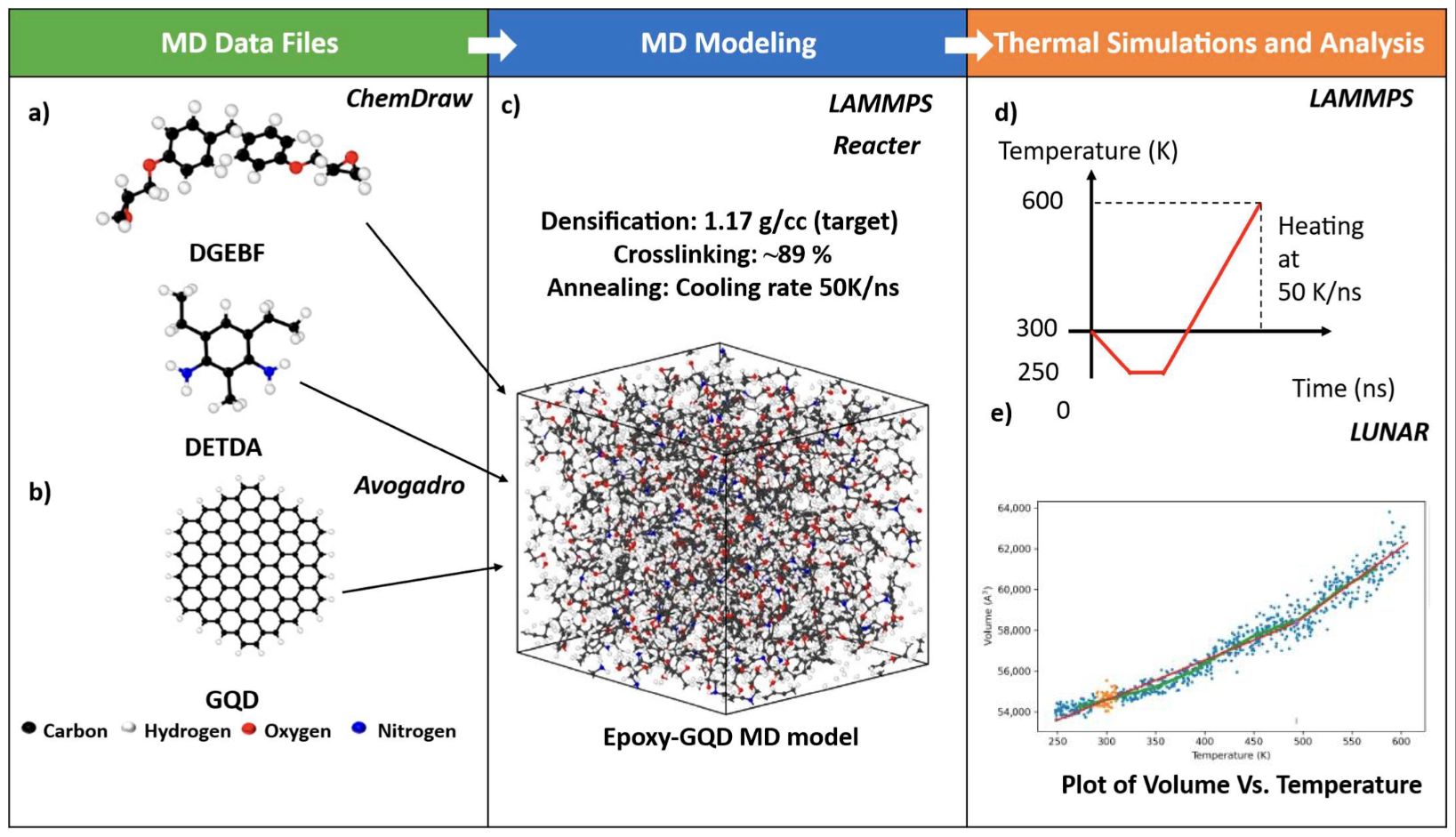
The model system combined DGEBF resin and DETDA hardener in a 2:1 stoichiometric ratio with a pristine GQD or six functionalized variants. Amine and carboxyl groups were placed at GQD edges; hydroxyl and epoxide groups were placed on the surface; one model combined surface epoxide and edge carboxyl groups. The workflow linked molecular structures, crosslinked epoxy–GQD models, thermal cycling, and volume–temperature analysis to estimate glass-transition temperature (Tg), thermal shrinkage, and coefficient of linear thermal expansion (CTE).
The result was not that every GQD improved the resin. Pristine GQD lowered the modeled Tg, consistent with additional free volume and nonbonded interactions. Functionalization reversed that trend: surface oxygen functionalization produced the largest modeled increase—up to 16% relative to neat epoxy—while amine- and carboxyl-functionalized GQDs produced increases of about 7%. The neat-epoxy Tg prediction, 159 ± 7 °C, agreed with a previously reported experimental value of 156 °C, but the nanocomposite results themselves were not experimentally validated in this study.
The CTE result was more restrained. Most modeled changes above and below Tg were not statistically significant; the exception reported was a 4% increase below Tg for s4OH-GQD–epoxy. This distinction matters for experimental planning: chemistry that increases modeled Tg may not simultaneously reduce expansion, shrinkage, or residual-stress risk.
For our group, the practical next question is experimental: at matched loading and cure state, do surface epoxide/hydroxyl chemistries outperform edge amine/carboxyl chemistries when Tg, CTE, cure shrinkage, and interfacial mechanics are measured together? The simulations provide a ranked hypothesis—not a qualified material or application.
The work was supported by NSF CAREER award 2450841 and used UNC Charlotte’s ORION high-performance computing cluster.
Featured image: MD workflow from molecular structures through GQD–epoxy modeling and thermal analysis, Figure 3 from Bamane and Keleş, Applied Nano 6, 15 (2025). Source article. Reproduced under the CC BY 4.0 license; resized for web with no substantive changes.