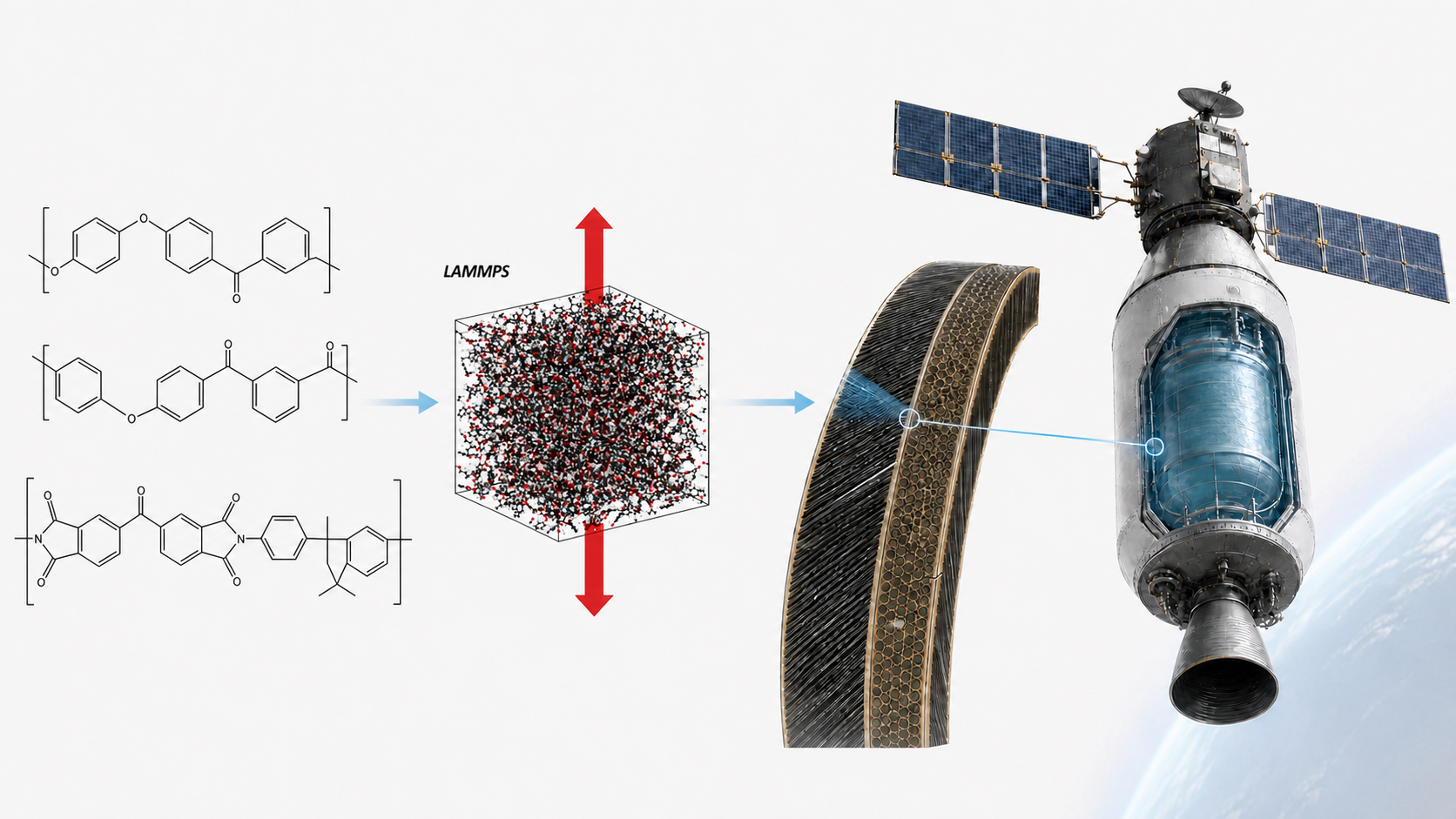
Screening polymer matrices for cryogenic applications — a Materials & Design study
- Post by: Ozgur Keles
- March 15, 2026
- Comments off
Lightweight composite tanks for cryogenic service require polymer matrices that can tolerate extreme cooling without excessive shrinkage or large changes in mechanical response. Testing every candidate experimentally is slow and costly, so computational screening can help decide where to begin.
Led by first author Swapnil S. Bamane, our collaborative study, “Investigation of material properties of thermoplastic and thermoset polymer materials at cryogenic temperatures using molecular dynamics,” appears in Materials & Design, Volume 263 (March 2026), Article 115689.
The molecular-dynamics study compared modeled thermal shrinkage, mechanical-property response, and free volume across thermoplastic and thermoset candidates. Across the systems examined, thermoplastics showed lower modeled shrinkage and smaller cooling-driven changes in mechanical properties than the thermosets. Crystalline and semicrystalline PEEK also showed lower free volume, while PEEK, LM-PAEK, and polyimide emerged as candidates for further evaluation.
The practical value is a narrower experimental search space. For follow-on validation, we would examine permeability, thermal cycling, microcracking and fracture, manufacturing defects, reinforcement–matrix interfaces, and tank-scale performance.
This is a screening study, not qualification of a polymer or a tank design.