Research
Ultrafast Light for Materials Synthesis and Manufacturing
How an ultrafast pulse determines what forms, where it forms, and whether it lasts
We investigate the largely hidden sequence from femtosecond excitation through the first microseconds of material formation. Our goal is to discover the mechanisms linking pulse history to material outcomes, predict the resulting composition, phase, and structure, and translate those rules into programmable—and ultimately parallel—laser synthesis and manufacturing.
We design time-resolved experiments to resolve transient species and constrain competing pathways. Physics-informed models help discriminate among mechanisms and prioritize the next informative experiment. Measurements of stability, mechanics, and reliability provide the final test of whether the resulting material, interface, or structure persists and performs.
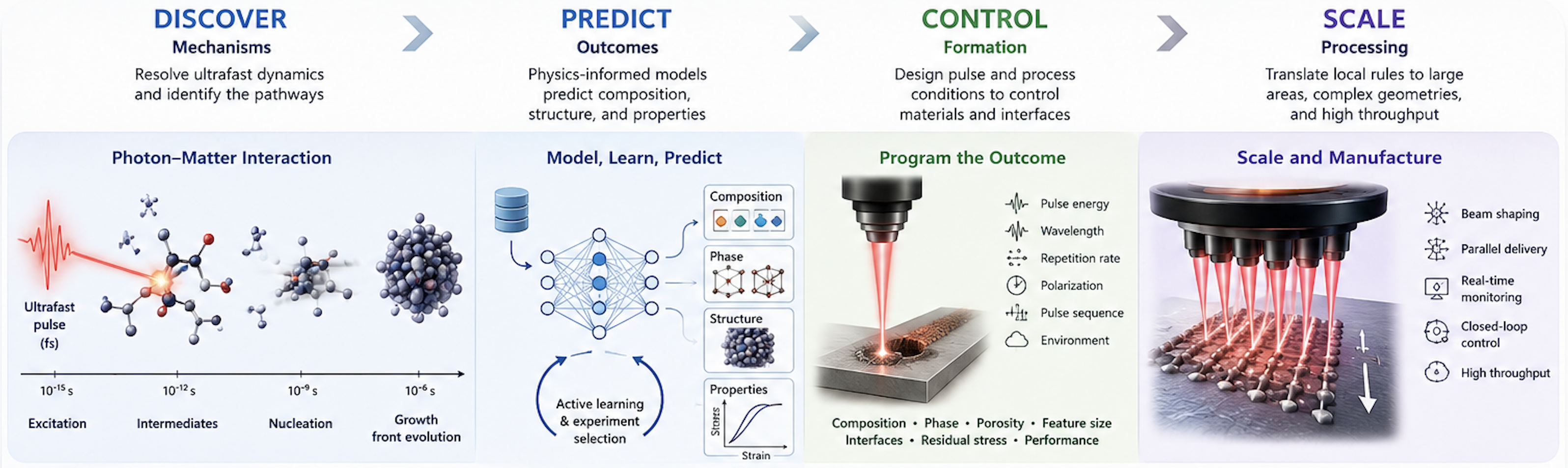
Ultrafast Materials Formation
Discovering photon-activated mechanisms from molecular excitation to material formation
What happens after a precursor absorbs light—and which intermediates persist long enough to contribute to nucleation and early growth?
We treat the laser focus as a pulsed chemical reactor. Each pulse can create excited states, fragments, and reactive intermediates. During the interval before the next pulse, these species may relax, recombine, remain coordinated, persist, or accumulate. Intermediates that persist may contribute to nucleation, while early material formation can alter the optical, thermal, transport, and interfacial conditions encountered by subsequent pulses.
We design time-resolved experiments to determine whether and how early intermediates contribute to nucleation and growth, and how pulse history influences composition, phase, morphology, porosity, surface chemistry, and feature size.
Our published study of carbon and graphene quantum-dot formation and surface functionality provides a foundation in precursor conversion, surface chemistry, and synchrotron-based materials characterization.
Current work maps the lifetimes of precursor-derived carbonyl species and develops experiments that connect transient molecular intermediates to early material formation.
Programmable Laser Manufacturing
Translating local process rules into reliable and scalable fabrication
How can local mechanistic understanding be transferred across larger areas and multiple processing sites?
To reach larger spatial scales and higher throughput, we study how optical pattern, pulse sequence, wavelength, polarization, and local dose determine geometry, microstructure, defects, interfaces, and residual stress. The long-term objective is to move beyond empirically tuned process windows toward transferable rules for spatially registered, repeatable, and eventually parallel fabrication.
Our published work on additively manufactured polymers and composites provides a foundation in manufacturing reliability: a structure must be not only writable, but repeatable and mechanically credible. Those studies quantify how porosity, architecture, orientation, interfaces, and defects influence fracture, variability, and mechanical performance.
Building on femtosecond-laser processing and two-photon writing, planned platform development includes time-resolved optical detection, synchronized acquisition, structured process metadata, and machine-vision registration. Spatial beam shaping, multifocus delivery, and parallel processing are subsequent stages.
Shared engine
Measure, Model, Select
Time-resolved measurement and model-guided experimentation
We design time-resolved measurements to discriminate among competing mechanisms. Physics-informed computation helps rank conditions, expose failure modes, and select the next informative measurement or processing condition.
Our current emphasis is model-guided, human-in-the-loop experimentation. We reserve the term closed-loop autonomy for workflows in which a measured result updates the decision model and the system selects and initiates the next experiment. Programmed control and automated parameter sweeps alone are automation.
Cross-cutting foundation
Mechanics, Interfaces, and Reliability
Testing whether materials, interfaces, and structures persist and perform
Making a material or writing a structure is only the first step. Across both research thrusts, interfaces, residual stress, fracture, variability, thermal mismatch, and long-term stability are treated as design variables rather than downstream checks.
This foundation connects the emerging laser program to our published work in stochastic fracture, additive-manufacturing reliability, quantum-dot–polymer interfaces, multiscale mechanics, machine-learning analysis of stress and failure, and polymer performance at cryogenic temperatures.
Process → structure → stress → function and reliability
Long-Term Vision
A Causal Language for Photon-Programmed Matter
Our long-term objective is to move beyond empirically tuned laser processing toward a transferable causal language for photon-programmed matter: an experimentally constrained framework linking photon energy deposition and transient material response to the composition, phase, morphology, porosity, geometry, interfaces, and performance of the resulting material or structure.
Within photon-activated synthesis, this means connecting the short-lived molecular species created by each pulse, the intermediates that persist, nucleation, and growth-front evolution to composition, phase, morphology, porosity, and feature size. Within programmable manufacturing, it means connecting programmed optical fields and localized transformations to geometry, interfaces, residual stress, and function.
Such a framework could make laser-driven synthesis and manufacturing more predictive, reveal questions obscured by trial-and-error processing, and enable materials, structures, and functions that are difficult to realize using conventional methods.
Experimental Platform and Facility Access
Current foundation
- Femtosecond-laser processing
- Two-photon writing
- Materials preparation, mechanics, and computational modeling workflows
Planned development
- Time-resolved optical detection and synchronized acquisition
- Structured process metadata and machine-vision registration
- Model-guided selection of subsequent conditions
Subsequent stages
- Spatial beam shaping
- Multifocus and parallel delivery
- Measurement-driven execution of subsequent experiments
Prior facility research
- Synchrotron-based studies of material structure and surface chemistry
Scheduled and proposed facility studies
- SLAC/SSRL experiments later in 2026: We will visit SLAC later in 2026 to conduct time-resolved X-ray experiments for ultrafast laser nanomanufacturing.
- Longer-term time-resolved X-ray experiments at LCLS spanning ultrafast excitation and early material formation
Work With Us
We welcome technically focused collaborations in ultrafast materials formation and time-resolved spectroscopy; programmable laser processing, beam shaping, and parallelization; mechanics, interfaces, and reliability; and physics-informed, model-guided experimentation.